Home Page
Welcome to the home page of the International Society for Fungal Conservation [ISFC], the first society anywhere in the world to be entirely devoted to protecting these beautiful and wonderful organisms. Established in August 2010, it now has more than 300 members in over 60 different countries. The Society promotes conservation of fungi globally through activities, awards, campaigns, meetings and publications. [More...]
Declaration of Cotonou
On 7 November 2025, at the Closing Ceremony of the Fourth International Congress on Fungal Conservation [ISFC4], in Cotonou (Benin, West Africa), Delegates unanimously agreed to The Cotonou Declaration on Fungal Conservation. The text of that Declaration can be downloaded here.
The Fungal Conservation Pledge
In November 2024, thanks to a brilliant and far-sighted action spearheaded by Fundación Fungi, the governments of Chile and the UK presented a special document called The Fungal Conservation Pledge to the Rio Convention [CBD] Conference of the Parties in Cali, Colombia. This document calls on governments worldwide to recognize that fungi constitute a separate biological kingdom equal in importance to the kingdoms of animals and plants, to acknowledge that they too need protection, and to give them equal priority in CBD plans and policies. Just prior to its launch, your President wrote personal letters to every CBD National Focus Point, urging them to add their country's name in support. By the end of the Cali Conference of the Parties, twelve countries (Benin, Cambodia, Chile, Colombia, Costa Rica, Ecuador, Germany, Guinea, Mexico, Peru, Spain, UK) had formally pledged to protect fungi and, since then, two more (Armenia and Ethiopia) had added their names. Our Society continues in to promote the Pledge, and Members are encouraged to download a copy, and send it with a letter of support to their country's CBD National Focus Point. A list of primary national focus points can be found on the CBD website.
Mainstreaming Fungal Conservation - a report on the Fourth International Congress on Fungal Conservation [ICFC4], Benin, West Africa, 3-7 November 2025
The Society's Fourth International Congress on Fungal Conservation was held in Benin, West Africa, 3-7 November 2025, and was hosted by the University of Parakou. The Congress theme, Mainstreaming Fungal Conservation, highlighted the huge progress made over recent years in gaining acceptance that, when it comes to extinction threats and need for protection, fungi are just as important as animals and plants. [More...]
Featured on this website
Fungi are different from animals and plants. There are probably more than 1.5 million species of fungi worldwide of which less than 10% have so far been discovered. Collectively they form their own independent megadiverse biological kingdom. [More...]
Fungi are incredibly important. The range of ecosystem services provided by fungi is enormous. While plants produce and animals consume, fungi are the great recyclers. Without them, life on this planet would not be sustainable. [More...]
Fungi need protection. The conservation movement almost totally overlooks the fungi. That is a big problem because there is no magical property which makes fungi immune to habitat destruction, pollution and climate change. [More...]
Information from the Third International Congress on Fungal Conservation
The Society's main meeting, the Third International Congess on Fungal Conservation was held in Turkey from 11-15 November 2013). The Congress Website can still be viewed, and the Programme and Abstracts Volume is now available on-line.
Is YOUR country getting it right? The Micheli Guide to Fungal Conservation evaluates Rio Convention reports from a fungal perspective. [More...]
Help publicise the Society. Download designs from the Society website and make your own custom T-shirt or hat to promote fungal conservation. [More...]
An easy way to raise the profile of fungi. Learn to edit Wikipedia and help it present a balanced view of fungi. [More...]
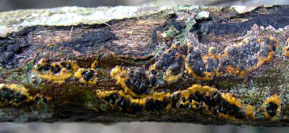
Have you seen this fungus? Cryptomyces maximus is distinctive and easily noticed, but now known only from a handful of sites in Wales. [More...]